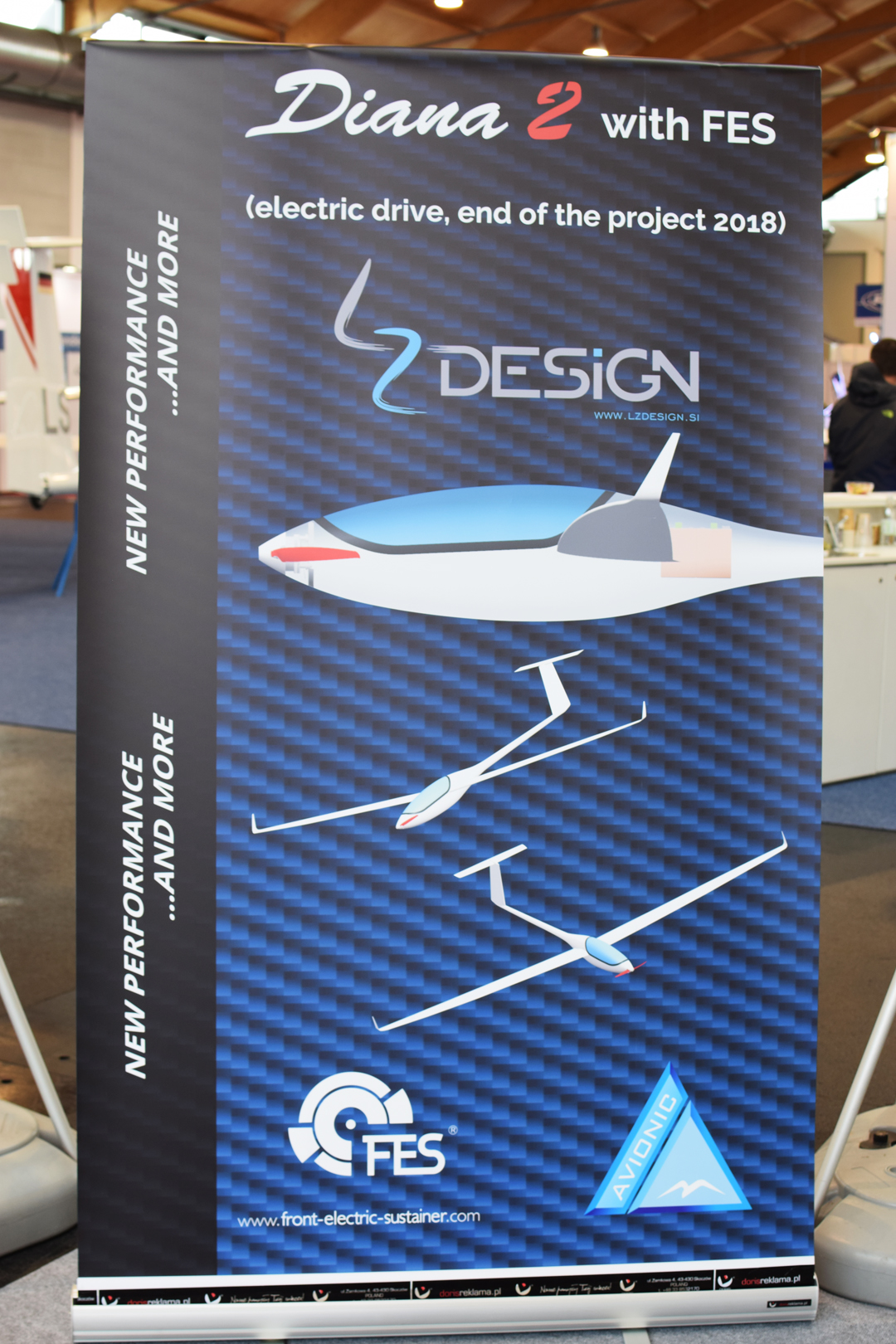
|
GIGANTIC
VICTORY FOR POLISH GLIDING!
Sebastian Kawa, flying the Diana 2
designed by Bogumil Beres, won the FAI
WORLD GLIDING CHAMPIONSHIP 2007 in Omarama, New Zealand.
The Diana 2 won against ten Ventus 2ax's plus four ASW 27, two ASG 29 and
one LS6. What a Victory! One polish glider in a glider competition against
17 german gliders flown by the best competitive pilots in the world.
Congratulation to Bogumil Beres, designer of the Diana 2, and his crew for
developing such a beautiful machine in his shop in Bielsko Biala. Bravo!
Bravo Bravo.
Also, congratulations to Sebastian Kawa and his coach Jacek Dankowski for
working out a strategy that fully realizes the potential of the glider
during the mountain flight and bringing victory with the Diana 2.
Remember, for this big victory we are indebted to many people that are not
mentioned here. And finally, it is the victory that counts so let's
celebrate it!
Janusz Centka Gold Medal!!
Karol Staryszak Silver Medal!!
This year the European Championships
took place in Issoudun, France. In the 15 meters class we could observe
two Diana 2 sailplanes, both flown by Polish pilots Janusz Centka
and Karol Staryszak.Janusz Centka won the European Championships with the
total of 5378 points. The second position and silver medal went to Karol
Staryszak 5158 points.
Congratulations you both and wish
you good luck flying those great sailplanes in future.
http://www.egc2007-issoudun.fr/home.php
Janusz Centka is a World Champion!!
During the 2006 World Gliding Championship in Eskilstuna, Sweden, Janusz
Centka flew the
Diana 2
and won the World Championship in the 15M class. Out of 10 days of flying,
Janusz placed first 3 times. On the second to last day, he was in 2nd
position, but Janusz placed first the last day and won the World
Championship. Web page:www.wgc2006.se

Congratulations Janusz ! You did a beautiful job !

Region 6 North
During the World Gliding Championship in Sweden, another Diana 2 flew in
the Region 6 North contest in Ionia, Michigan, USA. Jerry Zieba placed 2nd
overall. On the 5 tasks he was placed: 6th, 2nd, 5th, 2nd, 1st.
Web page: www.ssa.org
Next Diana 2 is flying !

First flight of Diana 2 "ZJ"
On November 4, 2005 Diana 2 "ZJ"
(N556DS) flew for the first time. Test Pilot Mariusz Stajewski made two
flights to 8000 ft. First one without water, second with full water.
Everything was OK. This glider is coming to the USA.
Sebastian Kawa won 1st Sailplanes Grand Prix!!!
 
Janusz Centka flying Diana 2 finish 2nd in 15m EGC 2005!!!
 
Janusz Centka
won 5 days!!!
Steven Raimond won 3 days. Henrik Breidahl won 1 day.
Werner Meuser won 1 day. Milos Dedera won 1 day.
All results and IGC file on EGC 2005 web page:
http://egc2005.fi/results/
Diana 2 has flown its
maiden flight!!!
January 12, 2005. The
Diana 2, a new 15m class ship designed by Mr. Bogumil Beres, has
flown its maiden flight, guided by the hand of a test pilot Mr. Mariusz
Stajewski. Today's test flights totaled at three flights and have been
considered very successful.
   
Diana
2 is ready for the first test flight!
   
New wings for Diana 2 are
made!
On September 24, 2004 Mr. Beres and his BPB
factory put together two new wings for Diana 2.They are looking great! The
two halves fit perfectly. The surface also looks perfect. Another amazing
thing is the weight of the wing. The new wing is 0.48 square meters bigger
than the Diana but the weight is the same - 44kg.
One wing can take 120 liter (120kg) of ballast!
After checking the profiles and surface, Mr Beres and Mr. Kubrynski said,
"Right now we are sure that we going to be 52:1."The fuselage is
also done. Right now they have to fit it all together and go flying. The
first test flight is scheduled towards the end of October. Same of you may
ask why it took so long to make the wings. Believe me, this kind of
quality needs time. The first delivery is scheduled for spring 2005 as we
promised.
 
|
SZD-56-2, Diana
2: Newest 15-meter Sailplane
The technologically advanced SZD-56-2
Diana 2 will
soar on new wings next summer. Bogumil Beres, chief design engineer of
the
Diana
and owner of Biuro Projektowe "B" Bogumil Beres, recently
announced the design project of a breakthrough
Diana 2,
featuring a curved wing platform with a continuously varying airfoil
and high-performance winglets. The original
Diana
fuselage will be retained, but with a lower drag fuselage-wing
junction. The wing loading range will be 6.08 - 11.7 psf.
Most remarkably, the
Diana 2
will break the long-standing 15-meter glide ratio barrier of 50/1 with
room to spare: forecast performance includes a max L/D of 52/1.
Krzysztof
Kubrynski Ph.D of the Warsaw Institute of Technology has created the Diana
2
airfoils using his custom 3-D computer software. Mr. Kubrynski has
worked extensively with Delft University's Prof. Loek Boremans, who
has designed airfoils for many of the latest German competition
sailplanes. The prototype
Diana 2
wings will fly next August. Diana
2's
will be delivered in the Spring of 2005.
Janusz Centka 1000
km triangular !
December 10, 2002 FAI
ratified Janusz Centka World Speed Record over a
triangular course of 1000 km:
144.95
km/h
Janusz has flown SZD 56.1 -
Diana, N256DS, "ZJ"
His short story.
The forecast looked good
for July 30, 2002, so early that morning I got ready for my 1000 km
flight. Kempton Izunu, the weather guru in Nevada, suggested a
triangular task with the first turn at Jackpot, 300 km north of Ely.
But, because of the smoke from many forest fires in California, I
chose a new second turnpoint, 300 km west of Ely.
I launched at 11:15 AM,
and made a perfect start at 11:30. My first thermal, a 9-knotter, took
me to 15000 feet MSL. The early thermals on course were mostly 8
knots, but as fast-moving cirrus arrived from the west, the thermals
gradually weakened, forcing me to fly left, and then right, of course.
At one point, I had to deviate 15 miles off-course, where I finally
found a 5-knotter and climbed to 12000 feet MSL above the first
turnpoint.
On the second leg, the
weather improved, and I was able to fly cloud streets in 15 to 20 mile
segments without circling. After about 60 miles, the cirrus again made
its presence felt. Inter-thermal distances increased as good lift
became progressively harder to find, and I had to make do with 5 and
6-knot lift. Then Cu Cong began to form nearby, along with scattered
showers. Finally, with 60 miles to go to the second turn, things
suddenly looked much better. I found a 10-knot thermal and climbed
quickly to 17000 feet MSL. With good cu’s ahead, I reached the second
turnpoint a full hour ahead of schedule.
On the last leg, I flew too far north,
and missed a nice cloud street south of course. I was forced to fly
through rain under the dissipating Cu Cong. Luckily, I found lift on
the edge of light rain, and was able to make my final glide. Having
finished ahead of schedule, I considered flying a longer task, using a
third turnpoint. But the terrain around Ely had quit working, so I
landed. It was a magnificent flight for me, and flying Diana was a big
pleasure . It is a great glider.
.

|
|
| |
|
I
had the good fortune to pilot the first new production Diana at
the Uvalde 15 Meter Nationals and would like to offer a recount
of my impressions of this aircraft and how it performed against
the best pilots and sailplanes in the United States.
 Mr.
Jerry Zieba of Diana Sailplanes contacted me in April and kindly
offered Diana "Zulu Juliet" for me to fly in the 15M Nationals at
Uvalde. This aircraft would be the second production model Diana,
but the first aircraft produced by the newly formed Bogumil Beres
facility. The aircraft was finally shipped from Gdansk on 4 July.
Jerry picked it up in New York harbor on July 23. After a whirlwind
of driving and paperwork, Jerry miraculously arrived with the Diana
at Texas Soaring Association on July 29th.
With
no time for preparation and practice, I arrived in Uvalde on 1 August,
and conducted four practice flights prior to the competition. These
flights culminated with a winning speed of just under 100 mph on
the second practice day. My initial impressions of the Diana were
quite positive!
|
|
As
most people know, the trailer and assembly procedures are a bit
unusual in that the spar stubs are fixed to the fuselage instead
of to each wing. Substantial carbon fiber spar stubs protrude about
30" beyond either side of the fuselage. On assembly, the fuselage
is first rolled out of the trailer on a dolly which, by means of
a clever hydraulic jack, keeps the fuselage spar stubs above the
trailing edge of the wings. Upon removal of the fuselage from the
trailer, the ship is lowered until the main wheel is just on the
ground. The wings are then extracted from the trailer keeping the
leading edge of each wing above the fuselage spar as they are rolled
out. Some care is required to ensure that the wings are held sufficiently
high to avoid banging the spar stubs. However, this unusual practice
readily became routine and was aided by the extreme light weight
of the wing panels (approx 100 lbs ea.). As mentioned by "OC", handling
of the wing root is a challenge for the beginner in that there is
no spar stub to hang onto. Certainly, either technique or some type
of handling aid would take care of this. Overall, assembly is straightforward
and is aided by the light weight of the components.

The
quality of the components, fit and finish was at least equal to
the very best of the German ships. I ran my 2" wave gage over the
wings and could not find any noticeable sign of waviness. "Optically",
the wings were near perfect. However, the trailing edge of the left
spoiler did not seat perfectly. This condition seemed to disappear
in flight. The all-carbon construction gives the ship a very solid
and robust feel throughout.
The cockpit is
well laid out with the side stick on the right and all other controls
accessible by the left hand. There was never a need to "shift" hands
in flight as with some gliders. Actuation of the full span flaperon
was smooth as silk throughout the flap range. I "really" liked the
side stick. Actuation was smooth in both axis and seemed to cause
less fatigue on extended flights than a standard stick. However,
the Diana's ultrahigh roll rate does demand a relatively smooth
and precise technique.
The cockpit is
significantly more reclined than the typical racing class ship.
However, I would not describe it as "cramped". Leg room is a limiting
factor for pilots in excess of 6' in height. However, shoulder,
hip and elbow room were all much more generous than my Discus A.
The in-flight adjustable headrest was a nice feature.
|
 |
However, another inch or so of leg room would
be nice for taller pilots. As mentioned on the NG, I did fly most
of the contest barefoot. This did provide a little extra leg room,
but more significantly, my white tennis were causing very distracting
reflections. A good pair of darker colored deck shoes would have
solved this problem without compromising leg room. Ventilation is
good with a high volume demister in the nose as well as an "aimable"
vent located on the cockpit sidewall near the control stick. I did
note that the nose vent, if left in the full open position, becomes
unacceptably loud over about 80 kts. However, when the flow is "throttled
back", for higher speeds, it provides adequate ventilation and is
very quiet.
Visibility in
the Diana is outstanding. With the reclined seating, forward and
upward visibility is excellent. Behind, you can see the horizontal
and up front, a quick rock of the wings easily reveals any hazardous
traffic which may be ahead and directly below.
In
flight the Diana is very pleasant. I have never flown a glider with
such low adverse yaw characteristics. Full rate (ie. 3 seconds -
45 to 45) rolls into thermals can be done with only 2/3 rudder.
The resulting maneuverability provides a competitive advantage in
centering and rolling in and out of thermals. The Diana offers the
option to roll 90 degrees into a turn, change your mind and roll
back onto course without delay or significant penalty.
"ZJ" was recognizable to other pilots from some
distance simply by the extremely agile manner in which the glider
maneuvered.
Performance:
Based on my experience in Uvalde, the Diana was equal to the best
of ASW-27's and V2's throughout the envelope. The ship did seem
particularly good in the important 90 to 110 knot range. On one
particular 55 mile, 110 knot, dead heat final glide, the Diana beat
a heavy '27 home by a comfortable margin. The Diana is limited to
10.3 PSF, which was perhaps a small disadvantage in Uvalde. Another
pound or so would have been nice under some of those incredible
cloudstreets.
Thermalling
is a joy because of the maneuverability, visibility and turn radius.
48 to about 53 knots seemed to be about right at gross weight. In
the larger gaggles, I could sometimes core the thermal in a much
smaller diameter and outclimb many of the ships. I never once had
the sense that any other ship, including the V2, had any advantage
in climb. I often ended up on the top of the weak pre-start gaggles
supporting my opinion that the ship would be excellent in light
conditions.
The
contest stats show that I was within a few tenths of 1% of the winner's
score on the AST days, but was about 5% off the mark on the PST's.
My continuing PST brain disconnects dropped my overall ranking on
the final day from 3rd to a still respectable 5th. Certainly, the
Diana can drag race with the best of them! Thanks again to Jerry
Zieba for entrusting me with his beautiful sailplane!
David Mockler aka Discus Driver "2XX"
|
|
|
|